


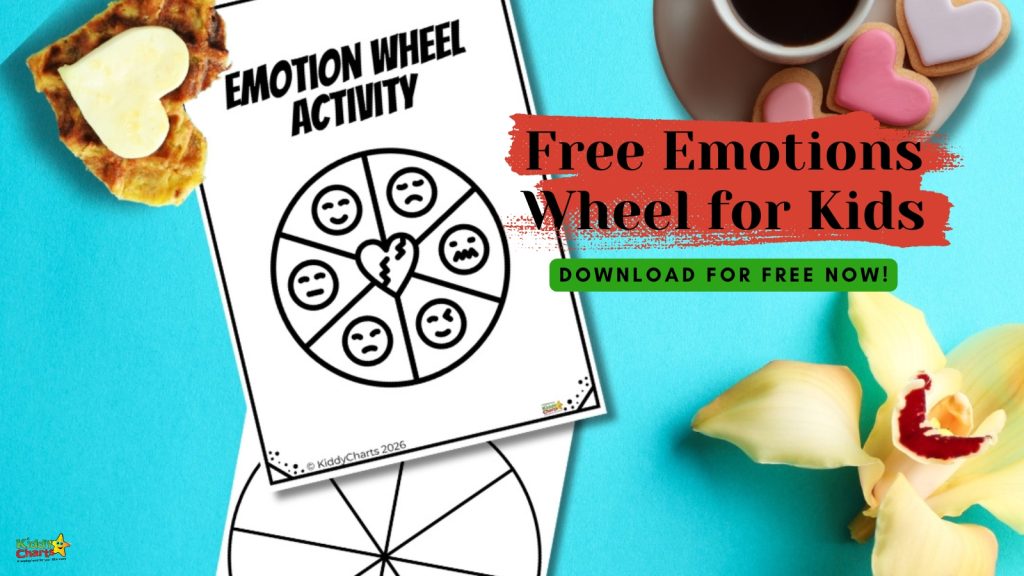
Feelings can be big, small, and sometimes confusing for all of us, especially children. Helping them understand and sometimes name their emotions is something that supports our kids well-being for life. Our brand new emotions wheel template activity is a wonderful, hands-on way to start these important conversations in a fun and creative way. The emotions wheel template is available as a printable resource for personal use, making it easy to print and use at home or in the classroom.

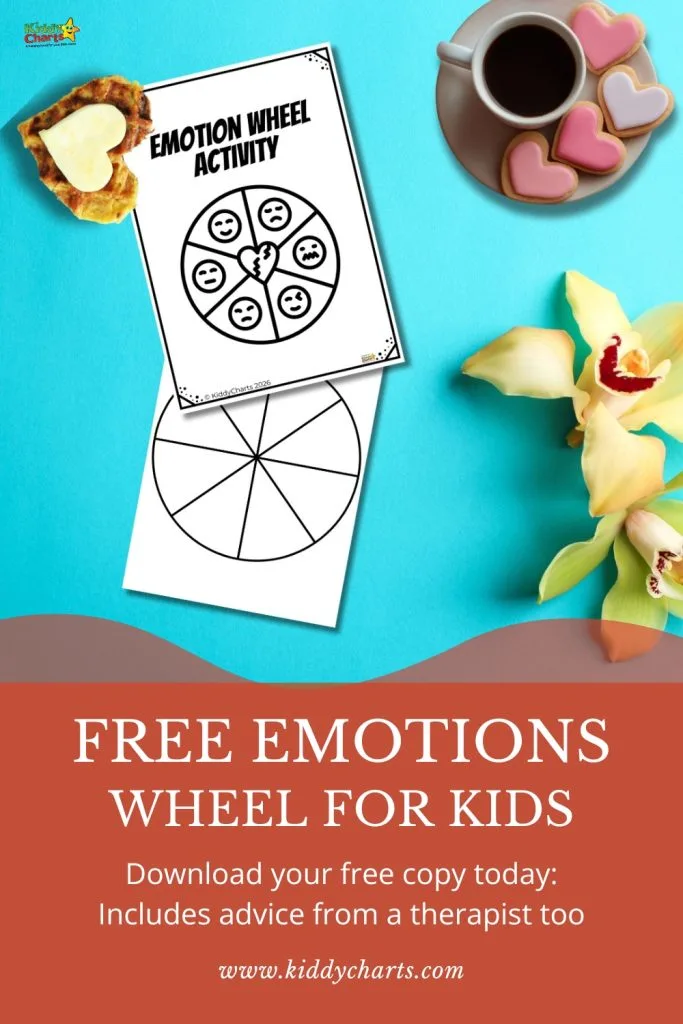
This activity helps children identify what they are feeling, communicate and discuss their emotions, express it, and learn that all feelings are okay. Let’s dive in and learn how to use this simple tool to build emotional intelligence together. We do have a my emotions wheel on the site too, as well as a mental health series for kids that you can sign up to for free. Check this out too:
Let’s have a look at the template we have here, and some strategies for exploring emotions too.
What is an emotion wheel?
An emotion wheel is a visual tool that helps us see the wide range of human emotions. Plutchik’s Wheel of Emotions is a well-known model featuring eight primary emotions. These are anger, anticipation, joy, trust, fear, surprise, sadness, and disgust, and arranged in opposite pairs. The wheel illustrates how emotions can intensify, with colors darkening toward the center to show stronger feelings. Each primary emotion has a polar opposite, and the layout typically includes a central core, secondary emotions around it, and tertiary emotions further out. For example, emotions like anticipation, disgust, surprise, rage, excited, playful, vitality, distress, negative emotions, uncertainty, danger, wait, expected, triggered, and hide can all be found or represented on the wheel. The Feelings Wheel by Gloria Willcox organizes over 72 emotions into six core areas, allowing for more specific identification of feelings.
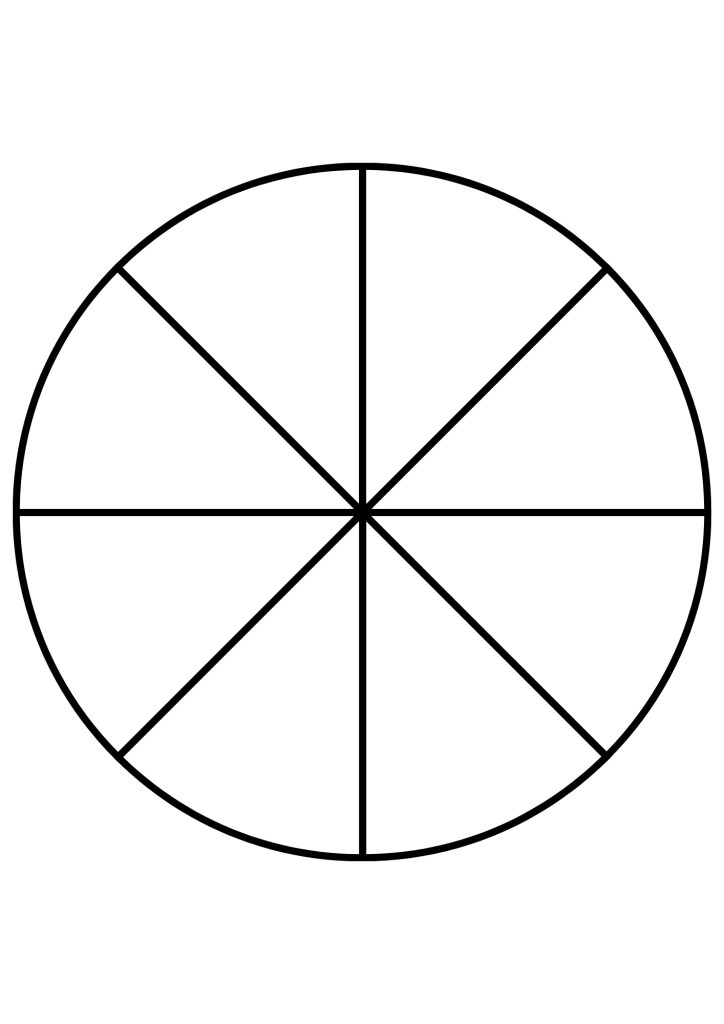
Our printable activity simplifies this concept for kids. It’s a circle divided into sections where children can name, draw, and colour different feelings. By creating their own wheel, they develop a personal connection to their emotions and learn that feelings can be layered and change throughout the day. The wheel helps students and individuals understand different emotional subjects and particular subjects, making it easier to effectively communicate and understand emotions. Having the right words for emotions is important for understanding emotions, and the wheel can spark ideas for emotional exploration.
We do also know that some people find it hard to name their emotions, and we cover this later on in this article.
Using an emotions wheel template provides a concrete way for children to think about abstract concepts like happiness, sadness, or frustration. It gives them the vocabulary and confidence to say, “I’m feeling angry”, hopefully providing another way of communicating their emotions, instead of acting out.

Why is understanding our emotions helpful?
When we understand our emotions, we can accept them better. Typically we talk about managing our emotions. However, our emotions are naturally, and actually it is more about accepting them and understanding they are OK. We put in an extra layer when we learn to regulate our emotions. Instead of reacting we apply a logical break and then react to our emotions following the break. Regulation isn’t about management, it is more about acceptance, understanding and then letting go. Think about it: if you know you’re feeling anxious, you can take steps to calm yourself down, like taking deep breaths or going for a walk. Children are the same. Naming, or understanding what is happening even if we don’t have a name for it, helps to acknowledge a feeling and might even give them power over it.
Daily emotional check-ins
Daily check-ins with the emotion wheel can help individuals locate their dominant emotions and understand emotional patterns.
Recognising emotions also helps with empathy. When a child understands their own sadness, they are better able to understand a friend’s sadness and offer comfort, if that is what their friend needs.
The emotions wheel template is a valuable tool for working through what are often perceived as negative emotions and can be especially helpful for those who have trouble expressing their feelings by providing the right words to label and discuss their feelings. This is a cornerstone of building strong, healthy relationships.
Remember emotions are information, they are often trying to tell us, so it is worth listening to them to understand what they are trying to say to us, and our children.
Understanding emotions and building emotional vocabulary takes practice and develops over a given time, but the emotions wheel template helps individuals do this effectively.
Listening to our bodies
Our bodies often give us the first clues about how we’re feeling. A “knot” in our stomach might be anxiety or uncertainty; sometimes uncertainty can feel like a fluttery or uneasy sensation in the stomach. A heavy feeling in the chest can signal distress, reflecting emotional pain or overwhelming discomfort. On the other hand, a warm, bubbly feeling in our chest could be excitement, and feeling energetic or lively throughout the body can be a sign of vitality. This is called interoception, our internal body sense.
Interoception is different for everyone. Your way of experiencing an emotion may well be different to someone else’s.
Body clues for emotions
Encourage your child to become a “body detective.” When they feel an emotion, ask them where they feel it. Sometimes this isn’t possible to do in the moment, so try and see if they remember what it felt like. If they don’t that is fine though. There is no shame in not knowing.
Some thoughts around this are:
- “When you’re angry, do your fists or your chest get tight?”
- “When you feel happy, does your body feel light and bouncy?”
- “Where does that sad feeling live in your body? In your throat? In your tummy?”
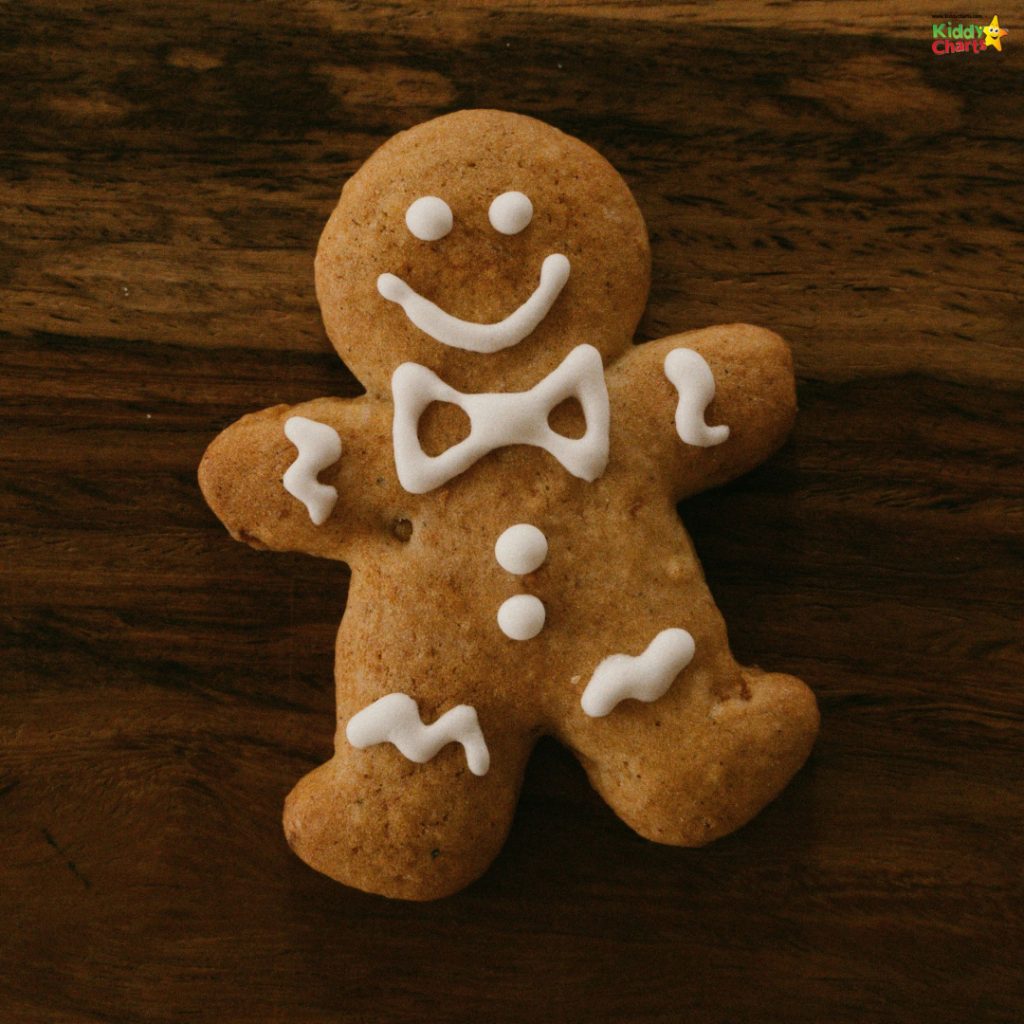
Sometimes it can help to draw a body outline to point to where your child thinks the feeling is. Or use a doll, or even a gingerbread man, and they can show you. Again, it is OK not to know too.
Connecting emotions to physical sensations makes them less scary and more manageable. It teaches children to listen to their body’s signals, a vital skill for self-regulation and mental health.
How to use the emotion wheel activity
This activity is simple, requires minimal supplies, and is perfect for a quiet afternoon at home or in the classroom. Interactive templates of emotion wheels are available in digital and editable formats for personal or therapeutic use. The activity is also suitable for students and can be easily incorporated into classroom settings to help them understand and manage their emotions. Additionally, the Junto Emotion Wheel is a simpler visual aid designed for professional settings, featuring core emotional regions with more nuanced layers.
Materials needed
- Our free printable emotions wheel template
- Scissors
- Crayons, markers, or coloured pencils
- A brad fastener (paper fastener)
- A pencil
- Printable feelings wheel templates are available for free download in PDF and editable formats, making it easy to print and use at home or in the classroom.
Step-by-step instructions
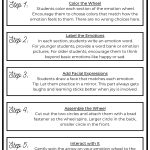
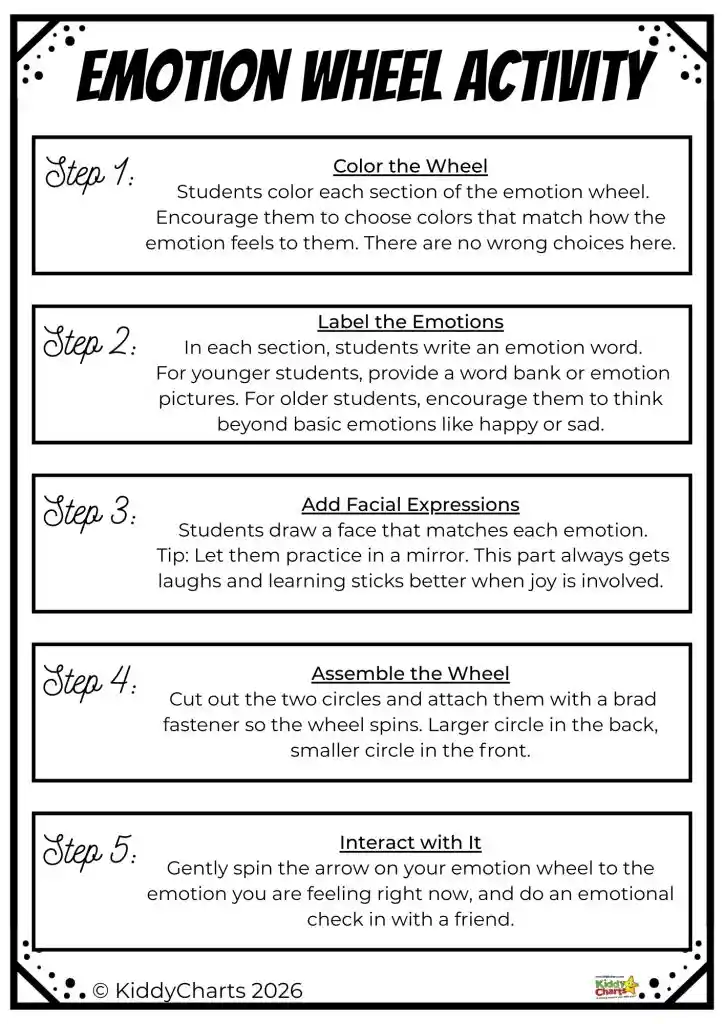
- Colour the wheel: Let your child colour each section of the wheel. Ask them to pick colours that feel right for each emotion. Maybe red feels angry, blue feels sad, and yellow feels happy. There are no wrong answers of course. This step allows for creative expression.
- Label the emotions: In each section, help your child write an emotion word. You can start with basic feelings like happy, sad, angry, scared, surprised, and calm. For older children, you can introduce more complex emotions like frustrated, proud, anxious, or content.
- Add facial expressions: This is the fun part. Encourage your child to draw a face that matches each emotion for them. Using a small mirror can be helpful and often leads to giggles. Making the faces themselves helps connect the feeling to the expression. For some children this is hard, and so it is OK to either skip this, or discuss how it feels to struggle with this. Opening up the conversation and normalising not knowing is so helpful for neurodivergent children in particular.
- Assemble the wheel: Carefully cut out the two circles and the arrow. Place the smaller circle on top of the larger one and push the brad fastener through the centre dot of both, and then through the base of the arrow. Open the prongs on the back to secure it. Now your wheel should spin! Most emotions wheel templates have a central core with primary emotions, secondary emotions arranged around it, and tertiary emotions further out. This layout helps a person see how complex feelings are connected. You can use another emotions wheel alongside this to help to illustrate what you are building, or just stick to what we have here.
- Check-In: Use the wheel for daily emotional check-ins. Ask your child, “How are you feeling right now?” Alternatively, for those that struggle with this, “What are you thinking right now?” They can spin the arrow to the corresponding emotion. This opens the door for a conversation about why they are feeling that way. The wheel can help a person realize when their emotions are triggered by certain situations, such as feeling frustrated when they have to wait or feeling sad after being excluded. Sometimes, waiting or taking a moment to reflect can help a person better understand and process their feelings. It can take time for people to process feelings too, so bear this in mind as well. It is OK to be unsure.

Recognizing and coping with feeling overwhelmed
Feeling overwhelmed is something everyone experiences at some point, whether it’s because of a tough day at school, changes at home, or just too many emotions happening all at once. Sometimes, all those feelings, like sadness, fear, anger, or even happiness, can pile up and feel too big to handle. That’s when the feelings wheel becomes a truly helpful tool.
Breaking down our overwhelming emotions
The emotion wheel helps us break down that overwhelming sense into smaller, more understandable pieces. For example, if your child is feeling overwhelmed, you can use the wheel to help them identify what’s really going on. Are they feeling sad because they miss a friend? Is there fear about something new or unexpected? Maybe there’s anger because something didn’t go as planned. By spinning the wheel and exploring each section, children (and adults!) can start to recognize the different emotions that are mixing together in that moment.
And don’t forget confusion because they don’t know what is going on – or even frustration at not understanding what is happening to them.
Emotional regulation strategies
Emotional regulation is all about being aware of what you’re feeling and learning how to understand, accept, and move on from those emotions in a healthy way. The feelings wheel can help you and your child notice when certain situations or people trigger intense emotions. For example, if your child realizes they always feel overwhelmed before a big test, you can use the wheel to talk about those feelings and come up with a plan to support them. Perhaps taking deep breaths, asking for support, or taking a short break.
It’s also important to remember that feeling overwhelmed is information for us. It is a signal from our bodies and minds that we might need a little extra care. Practicing empathy and self-compassion, which is being kind to ourselves when things feel too much, can make a big difference. Encourage your child to take breaks, do something relaxing, or talk to someone they trust. Sometimes, just naming the feeling and knowing it’s okay to feel that way can help reduce its intensity.
The feelings wheel isn’t just for kids. It’s a great resource for anyone, including adults and clients in therapy, who might struggle to identify or express their emotions. By using the wheel regularly, you can build the ability to recognize when you’re starting to feel overwhelmed and take steps to understand it before it becomes too much.
In the end, the emotion wheel is more than just a fun activity: it’s a powerful way to support emotional well-being, strengthen relationships, and help everyone feel more in control of their feelings. By recognizing and coping with feeling overwhelmed, we give ourselves and our children the tools to handle life’s challenges with greater confidence.

What if my child can’t name their feelings?
Some children and adults find it very difficult to identify and describe their emotions. This is known as Alexithymia. It doesn’t mean they don’t have feelings; it just means there’s a difference in recognising or naming them. This is more common than you might think, and it is perfectly okay. Having the right words for emotions can make a big difference in understanding and expressing feelings, which is why tools like an emotions wheel template are so valuable.
The work of occupational therapist Kelly Mahler is incredibly helpful in this area. She focuses on interoception, helping people tune into their body signals to understand their emotions better.
For a child who struggles, an emotions wheel template can still be a brilliant tool. Instead of forcing them to name a feeling, you can adapt the activity. It’s okay not to know. Sometimes, a feeling doesn’t have a name. It might be a colour, a shape, or even a sound.
Alternative ways to express emotions
Here are some ideas, all of which we can use in therapy rooms with both kids and adults:
- Use colours or drawings: Instead of writing “sad,” they could colour the section blue or draw a picture of a rainy day. OR most importantly: what works for them, and it might not be what we think would be the case. Let them lead.
- Pick an object: Ask, “If this feeling was an object, what would it be? A spiky rock? A soft blanket?”
- Make a sound: What sound does this feeling make? A loud “grrrr” for anger? A quiet “hummm” for contentment? Again – try not to lead, and let your children work through it themselves, and come up with their own ideas,
- Focus on the senses: Our senses are powerful clues. Ask, “What does this feeling taste like? Salty tears? Sweet chocolate?” or “What does it smell like? Fresh-cut grass?”
- Pick an image that helps express it: Use a game like Ouisi with lots of photographs and see if there is a picture that expresses how they are feeling.
- Explore a particular subject or subject of emotion: Encourage children or clients to focus on a particular subject or area of emotion, such as anger or joy, to help them better understand and label their feelings with the words that might work for them.
Expression not perfection
The goal is expression, not perfection. The most important message you can give your child is that whatever they feel, and however they express it, is valid and accepted. This builds trust and emotional safety, creating a space where they can explore their inner world without judgment.
Note: This printable emotions wheel template is intended for personal use only. It can be helpful for children, clients, or adults, but should not be sold, shared, or redistributed for commercial purposes.
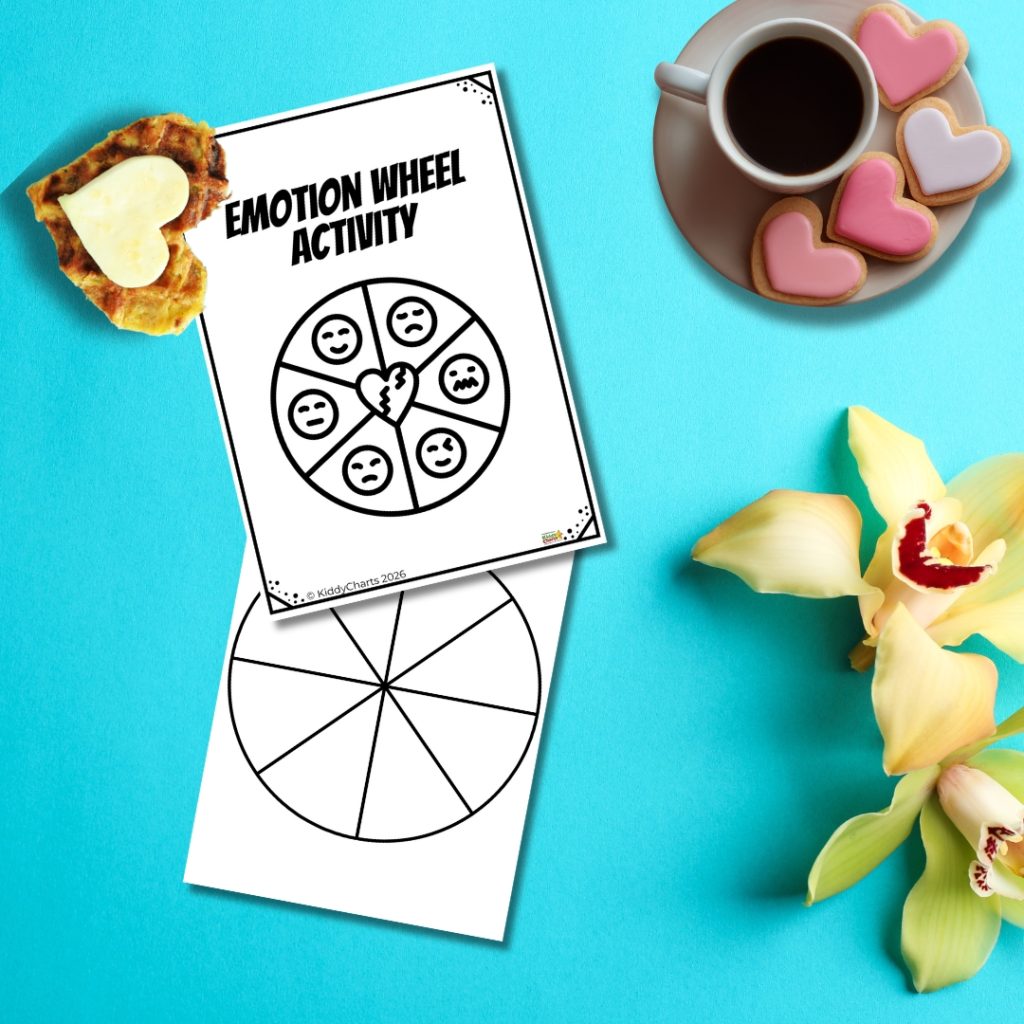
Download your free emotions wheel template
Ready to get started? This activity is a fantastic way to connect with your child and give them the tools to navigate their emotional landscape. By exploring feelings through colours, drawings, and conversation, you are building a foundation of emotional intelligence that will support them for years to come.
This emotions wheel template is available for print and personal use only. It is designed as a helpful tool for students, clients, and anyone interested in understanding emotions.
Download your free printable today and begin the journey of exploring emotions together.
We hope that this is helpful for you. Why not follow our site?
Here are some more ideas around emotions for you on KiddyCharts:
Here are some other ideas to help children to understand and cope with their feelings and emotions.
How to help your kids recognise their emotions: Free printable #31DaysOfLearning
A printable to help kids understand what feelings they are having.

Anxiety in kids
Ideas from KiddyCharts to help with kids expressing themselves, and focusing on improving mental health.

Positive writing prompts for kids emotional development #31DaysOfLearning
Writing prompts for children that focus on feelings, and emotional development.
31 Days Of Learning
Find all of our 31 Days of Learning events on one page! Print out our calendar and work your way through each activity! Have fun!


Friendship mindful activity for kids: Friends who lift my spirits most
Simple mindful activities for kids focusing on friends that lift us up.
And beyond too.
Activities to help your kids with their emotions
If you need more ideas to help your kids deal with their emotions then these posts are worth checking out and trying out.

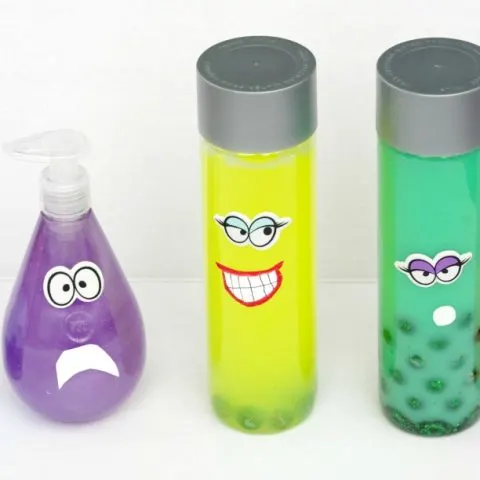
Emotions Discovery Bottles Inspired By Disney’s Inside Out
Help your kids recognise their emotions with these fun emotions discovery bottles inspired by Disney's Inside Out.
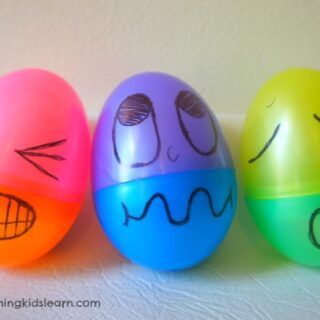
Tool for teaching emotions in kids
Use these tools to help teach kids about emotions.

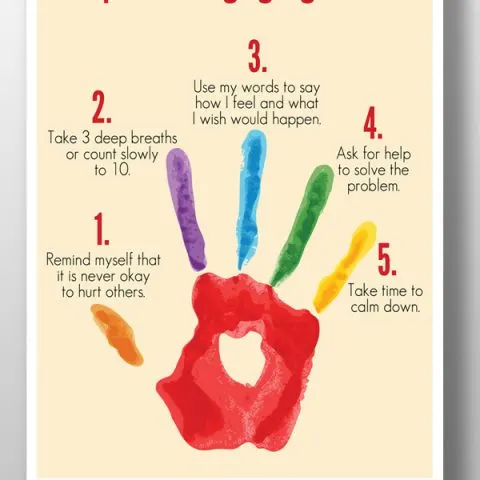
5 Steps to Managing Big Emotions: Printable
Join teacher Christie Burnett in this post where she shares 5 steps to managing big emotions in kids. There's also a free printable!
Thanks for stopping by, and do come back again soon.
Helen
Helen Neale

Helen is a mum to two, social media consultant, website editor and a qualified counsellor with experience of working with both children and adults. She is a registered member of the British Association of Counselling and Psychotherapists, with her own private practise. She also freelances with her local Mind organisation. Since giving up being a business analyst when juggling travel, work and kids proved too complicated, she founded KiddyCharts so she could be with her kids, use those grey cells at the same time, and supplement her counselling income. KiddyCharts has reach of over 680k across socials and the site. The site works with big family brands to help promote their services, as well as offering free resources to parents of kids under 10. She is a specialist counsellor for neurodivergent individuals and brings this expertise to her resources and the site. She is also an ADHDer herself. KiddyCharts gives 51%+ profits to charities, focused on supporting mental health and a community in Tanzania Helen has also worked as a digital marketing consultant (IDM qualified) with various organisations, including Channel Mum, Truprint, Talk to Mums, and Micro Scooters. She loves to be creative in the brand campaigns she works on. Get in touch TODAY!